
X Close The Algerian mouse (Mus spretus) appears at the highest altitude ever registered in Catalunya

After 18 years of continuous monitoring, the monitoring program for small common mammals (SEMICE) has recorded, in the Montseny Natural Park and Biosphere Reserve, the presence of the Algerian mouse (Mus spretus) at the highest altitude ever recorded in Catalonia. The discovery occurred between 8 and 10 July 2025, during sampling campaigns at the stations located in Turó de l’Home, where four juvenile individuals were captured.
During the spring-summer sampling campaign at the four small mammal monitoring stations currently in the Montseny Natural Park, more than 180 different individuals were captured (45 individuals per plot on average). These are exceptional results in terms of abundance, where two of the stations broke the historical record for captures: the juniper scrub and the beech forest of La Cortada.
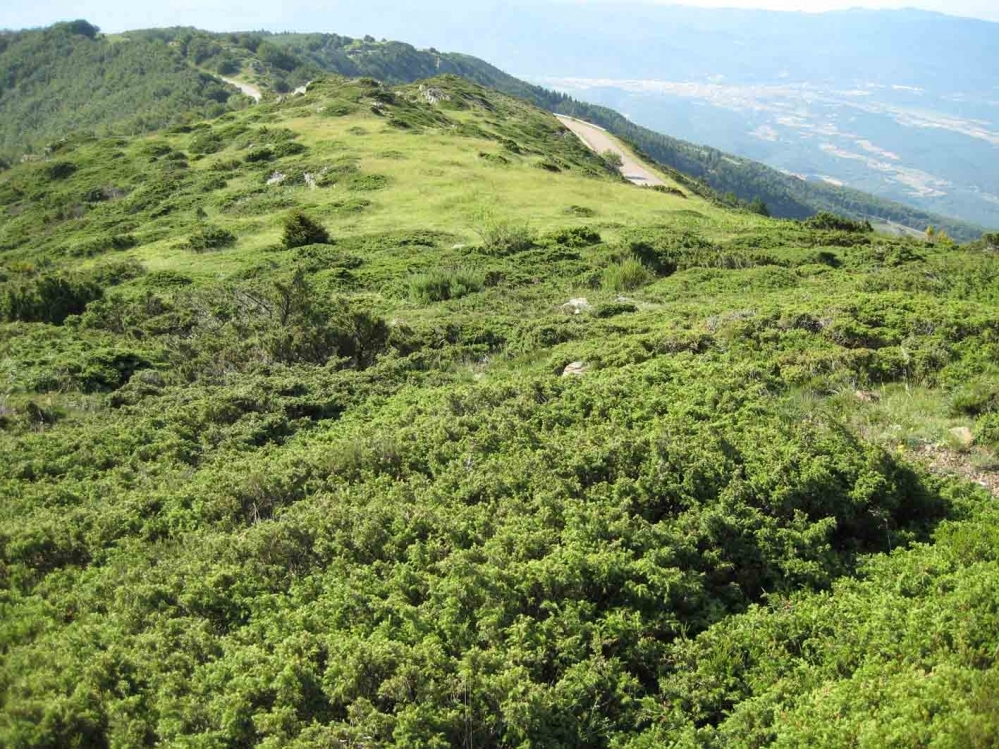
Views from the juniper thicket of Turó de l'Home, the monitoring station where the four field mice were captured during the sampling campaign.
Throughout this campaign in Montseny, the most detected species was the wood mouse (Apodemus sylvaticus), followed by the yellow-necked mouse (Apodemus flavicollis), the bank vole (Clethrionomys glareolus), the greater white-toothed shrew (Crocidura russula) and the common shrew (Sorex araneus). In addition, however, an unexpected species appeared: the Algerian mouse (Mus spretus). Its detection in the juniper thicket of Turó de l'Home was not surprising because it is a species that is not very abundant, since it is the protagonist of 12% of the SEMICE captures and on average appears in almost 30% of the locations that are sampled annually, but because it has never before been recorded at such an altitude in Catalonia.

Map of Algerian mouse (Mus spretus) citations obtained through the two protocols associated with SEMICE: live trapping (orange) and pellet analysis (green).
The Algerian mouse is a species of warm environments that is distributed along the western coasts of the Mediterranean Sea: Portugal, Spain, southern France, Morocco, Algeria, Tunisia and Libya. It is a mouse quite similar to the house mouse, since they belong to the same genus, but it does not tend to approach homes. It inhabits open environments, from agricultural areas to scrublands or poorly grazed meadows, and feeds mainly on grass seeds and fruits, although it also occasionally consumes insects.
Until today, in Catalonia there were no citations of the species above 1,200 m. The findings at higher altitudes were in Montsant (live trapping), in the Cerdanya plain (analysis of egagròpiles) and in the north of Solsonès (Ornitho.cat). This new record could simply be due to a one-off irruption, taking into account that this year a population recovery of the Algerian mouse is being observed, with abundance values (number of individuals captured) similar to those of 2019: one of the best years for the species since the start of SEMICE. It should not be forgotten, however, that in the face of the climate change scenario, several species of typically Mediterranean small mammals are expected to progressively expand their distribution range towards higher areas.
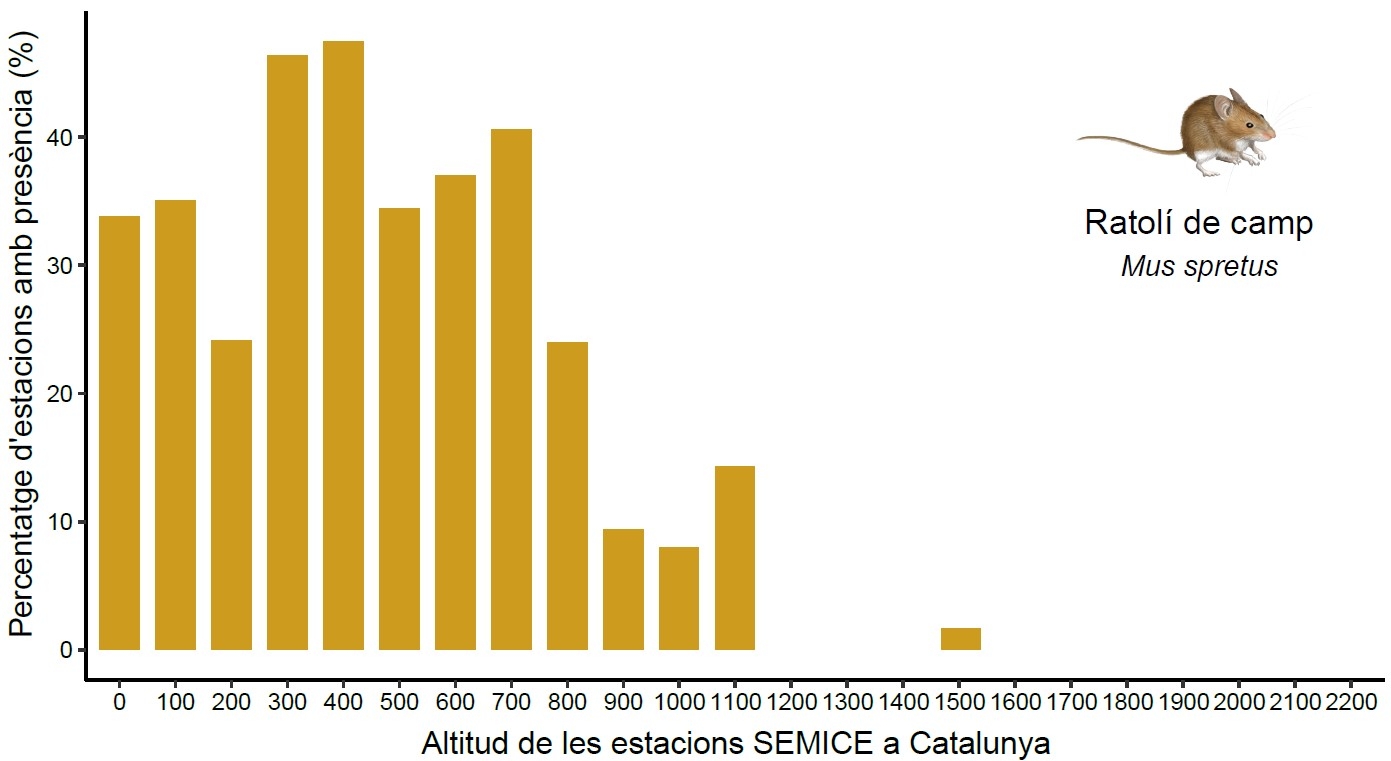
Figure showing how the presence of the Algerian mouse (Mus spretus) varies with increasing altitude at the sampling stations. The rightmost column corresponds to the observations obtained in July.
The monitoring of common small mammals (SEMICE), which has been in place for 18 years (2008-2025), is part of the collaboration agreement between the Barcelona Provincial Council and the Granollers Museum Board of Trustees to implement monitoring and research programs related to wildlife of conservation interest within the Natural Parks Network.
Return
Contact | Legal notes | Credits | Subscripció al butlletí

