
X Close Living in the edge. How population density and resources determine the survival of a hibernating small mammal
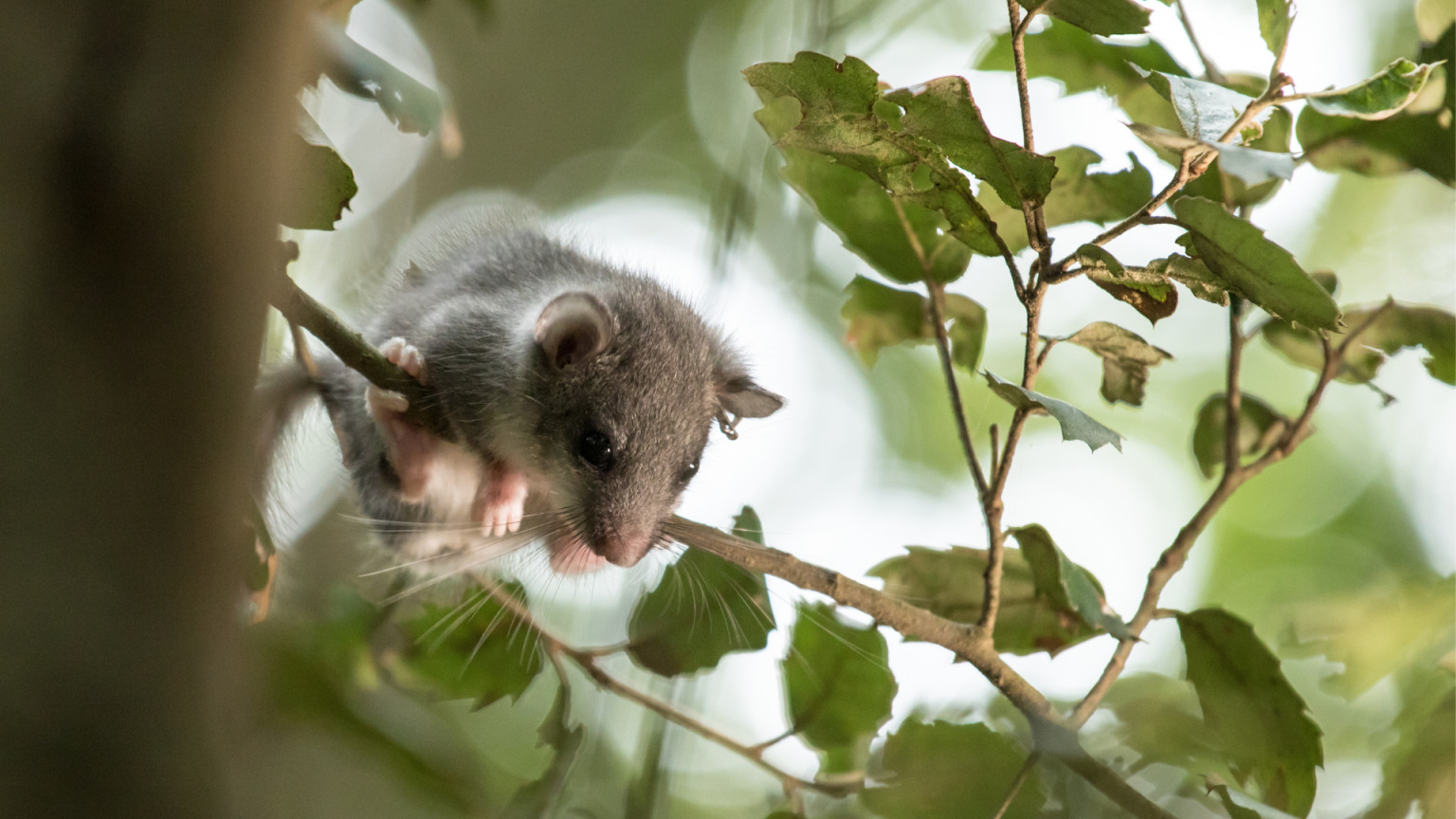
Researchers from CEAB-CSIC, CNR-IBE and the BiBio Research Group at the Natural Sciences Museum of Granollers have published a study in the journal Ecography revealing how populations of edible dormice (Glis glis) living at the edge of their range are adapting to more extreme environmental conditions in Catalonia.
In Mediterranean areas, where environmental conditions are more variable and extreme, dormouse populations live at the edge of their range and are particularly sensitive to changes in climate and food availability. The study focused on understanding how these factors affect the reproductive performance and dynamics of these populations in environments where seed and fruit production can vary greatly from one year to the other.
The study analyses data collected over a decade (2012–2021) in several study plots within the Dormouse Project (www.dormice.org) nest box monitoring programme located in deciduous forests in the Montseny Natural Park and the Montnegre and Corredor Natural Park, within the Barcelona Provincial Council's Network of Natural Parks (Figure 1). These boxes allow individuals to be tracked using the capture-mark-recapture (CMR) method, which can be used to estimate survival, reproduction and population size.

Figure 1. Map of the study region in the northeast of the Iberian Peninsula showing the location of the two study areas (Montseny and Montnegre). The blue dots show the recorded presence of dormice in the region in 10 × 10 km² in 2005–2006 (data from the Spanish Ministry of the Environment: https://www.miteco.gob.es/). The inner panel shows the distribution of dormice in the Western Palearctic (data from Viquipèdia).
In addition, the study incorporates precipitation and temperature data from the nearest Meteocat weather stations, as well as information on seed production obtained through regular sampling under trees in the study areas. These data have made it possible to analyse the relationship between climate variability, resource availability and population dynamics.
In Montseny, with its more humid climate and dense deciduous forests, there is a greater availability of beech seeds and other fruits, which favours a more opportunistic reproduction strategy: in years with abundant resources, females reproduce more and more successfully. In contrast, in Montnegre, where the climate is drier and seed production is more irregular, dormice display an adaptive strategy based on recruitment. In this area, the population is maintained thanks to the incorporation of new young individuals in favourable years, thus compensating for fluctuations in annual reproduction (Figure 2).

Figure 2. Temporal variability of (a) total abundance of then in the two study areas and (b) abundance of acorns and beechnuts in Montseny during the study. In Montnegre, beechnuts are absent and the total number corresponds to acorns. We used the total number of seeds counted in the sampling grids under the nest boxes as an approximation of seed abundance. We show Spearman's ranked correlation coefficient ρ and Kendall's W, which assesses the synchrony between the two time series in each panel.
The results also show that, in years with abundant seeds, the number of breeding females and the survival rate increase. However, when population density is high or environmental conditions are harsher (with dry summers or shorter winters), these benefits diminish. This indicates that population density acts as a natural regulatory mechanism, modulating the effects of climate and food availability.
This work demonstrates that edible dormouse populations living in the edge of their distribution have more sensitive and complex dynamics, in which the combination of density, resources and climatic conditions determines their resilience. The results provide key insights for the conservation of species vulnerable to global change, especially in Mediterranean ecosystems.

The monitoring of the edible dormouse is part of the collaboration agreement for the implementation of the Strategic Plan for Monitoring and Research for the Conservation of the Natural Environment (fauna: butterflies, small mammals, rodents, amphibians and reptiles) of the Network of Natural Parks between the Natural Sciences Museum of Granollers and the Provincial Council of Barcelona. of Natural Parks between the Granollers Natural Sciences Museum and the Barcelona Provincial Council.
The original publication can be consulted in the journal Ecography: https://nsojournals.onlinelibrary.wiley.com/doi/full/10.1002/ecog.07710
Photo credits:
Cover, young edible dormouse - Oriol Massana
Edible dormouse inside nest box - Lidia Freixas
Return
Contact | Legal notes | Credits | Subscripció al butlletí

