
X Close Dormouse Project 2024 season summary

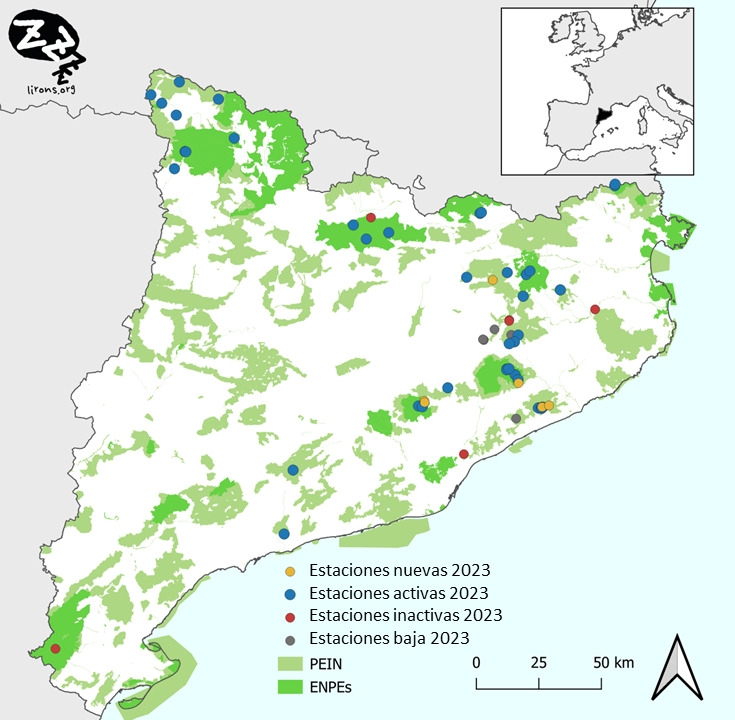
The monitoring station network of the project throughout 2024 has collected data from 96 active stations (862 nest boxes in total). A large part of these are located in Catalonia, but 40 stations are in Germany and 4 in La Rioja. In Catalonia, the network continues to grow and throughout 2024 data has been collected from 52 active stations (559 nest boxes in total).

In addition, within Catalonia there have been 4 basic stations (line of 6 nest boxes) that have switched to the advanced protocol (plot with 20 nest boxes): one in the Parc Natural de la Zona Volcànica de la Garrotxa, one in the Vall d’Aran, one in the Vall de Boí and one in the Parc Natural del Montseny. In addition, two new stations with basic protocol have been created: one in the Vall de Bianya (Garrotxa) and another in the Vall de Boí.


An important novelty of the project this year has been to standardize the protocols and thus improve the comparability of data between stations. From now on, stations with advanced protocol will have a plot format with 20 nest boxes and will include handling (capture-mark-recapture), while stations with basic protocol will have 6 nest boxes in line format and no type of handling will be carried out (presence-absence).

As for the results of the 2024 campaign, the values remain low, but unlike the Pyrenean stations, the Mediterranean stations show a slight rebound in captures compared to 2022 and 2023.

On the one hand, of the 26 active stations in Catalonia where the basic protocol is applied, dormice have been observed in 13 stations (50% of the total), with an average occupancy of 28.21%. In the Bosc de l'Oriol the maximum value has been recorded, with 66.67%.

On the other hand, among the 15 advanced protocol stations distributed throughout the different natural areas of Catalonia, dormice have been captured in 8 stations, with a total of 56 different individuals. Of these 56 dormice captured, 60.7% are adults (two or more years old), 12.5% are yearlings (one year old) and 26.8% are young (born in 2024). The proportion between sexes of the individuals captured leans towards males, with 73.2% males and 26.8% females.


With the objective of disseminating the monitoring of the edible dormouse and raising awareness of the species, various outreach activities have been organized, highlighting the 5th edition of the GLIS course in the Parc del Castell de Montesquiu in September, with 14 participants coming from various places and, thanks to the involvement of the different entities and collaborators, 6 Dormouse Days have also been carried out in different points of Catalonia, which have had more than 70 attendees. Finally, on December 14 we were especially excited to celebrate the 1st Volunteers' Meeting of the Dormouse Project, in the Parc del Castell de Montesquiu, with around twenty participants (here you will find the news of the meeting).

During 2024, from the project we have participated in congresses and specialist meetings, such as the 12th International Dormouse Conference in Germany, as well as in conferences in the parks of Montesquiu, Guilleries-Savassona and Montnegre i el Corredor. At the academic level, two scientific articles based on project data have been published:
- Direct and indirect effects of climate and seed dynamics on the breeding performance of a seed predator at the distribution edge. Daniel Oro, Lídia Freixas, Carme Bartrina, Silvia Míguez i Ignasi Torre.
- Diversity and plasticity of vocalisations in an elusive and arboreal small mammal: the edible dormouse. Carme Bartrina, César Llanos-Guerrero, Núria Valls, Lídia Freixas i Adrià López-Baucells.
Finally, there has also been a contribution to the update of the TERMCAT Dictionary of Mammals of the World, highlighting the new name of the "cellarda comuna" (instead of "rata cellarda"). In addition, César Llanos-Guerrero, PhD student of the project, has worked on a new detection method of the "cellarda", combining techniques such as nest boxes, camera trapping, acoustics and footprint tunnels, with results that we will share very soon.
Once again, thank you all for making it possible!!
Photo and video credits
o• Cver - Projecte Liró team
• Dormouse Days - Inés Piazuelo
• Cellarda work - Adrià López-Baucells
Return
Contact | Legal notes | Credits | Subscripció al butlletí

